Teaching music means everything to me. The procedure and the wonderful staff at Chu made the ability to pursue my passion a reality, at a time when I felt hopeless. I can’t imagine doing anything else, and I was faced with the possibility of having to figure out something else to do with my life.
I always felt like the absolute top priority when I was at Chu. Everyone knew me by name. I never thought of a medical institution as being such a friendly and supportive environment, almost like a family or team who really cared about me.


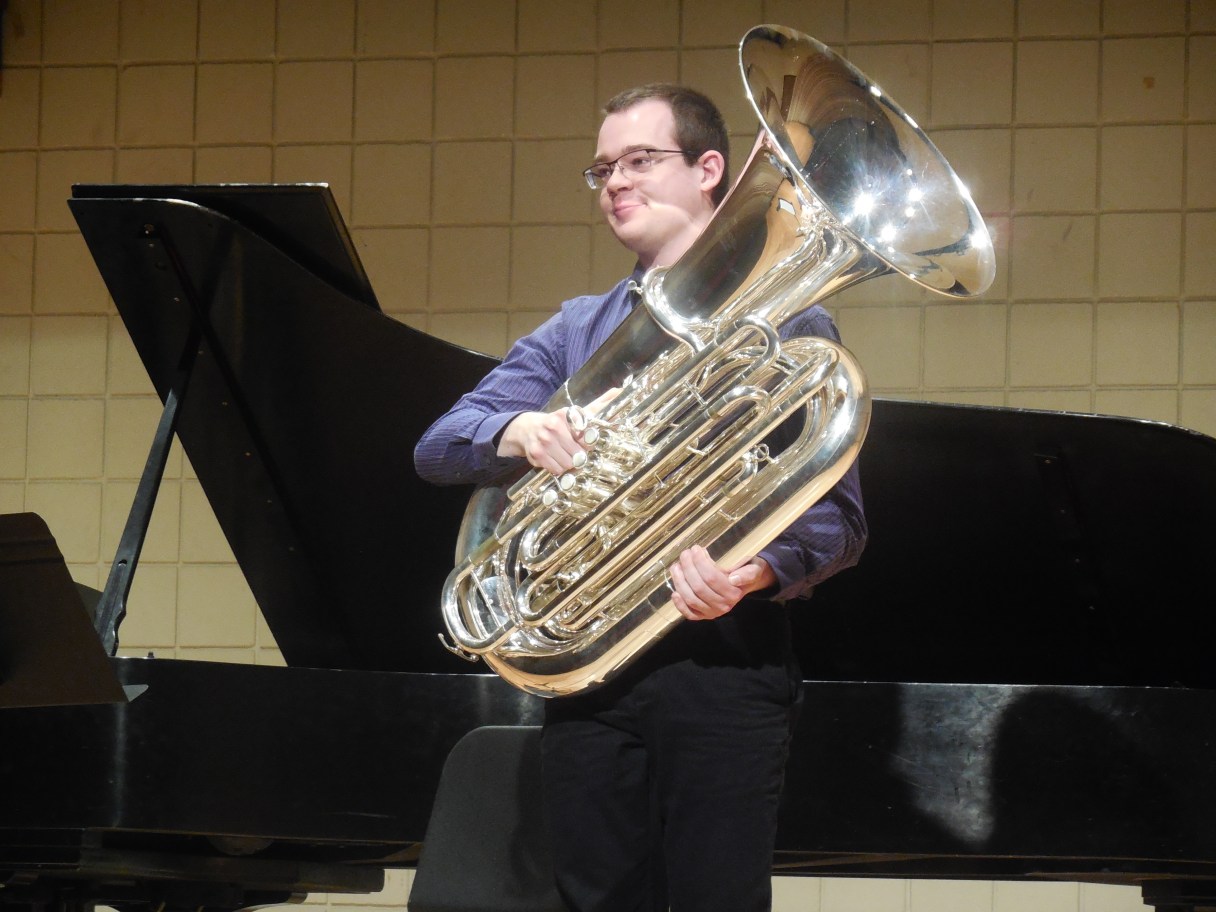
Jake is currently Band Director and Music Teacher in the Forest Lake, Minnesota, schools and community. At the age of 19, Jake’s progressive vision loss threatened his ability to pursue a lifelong dream of teaching music. After a friend referred him to a clinical trial being conducted at Chu Vision, Jake underwent corneal collagen cross-linking procedure to treat his loss of vision due to keratoconus, a progressive condition where the cornea loses its natural curvature. Keratoconus eventually advances to the point where patient cannot wear glasses or contacts and still see. Before the procedure, Jake’s best vision was 20/80 with glasses, and he was unable to pursue his studies or drive on his own. He is now able to see 20/20 with his glasses and is a vibrant community leader. We recently asked Jake to share his story of how vision restoration has enabled him to live his passion. Here’s what we heard from him:
Q: What’s your passion?
A: Teaching music.
Q: How long has music been in your life?
A: Since 6th grade. In 7th grade I decided I wanted to be a marching band teacher.
Q: How was your vision then?
A: Completely fine. I didn’t even wear glasses. It was completely fine until I was 16. Then from age 16 to 19, my vision deteriorated to the point where I couldn’t read, or drive, or do anything.
Q: And what was that like? To have your dream, and then watch it slip away from you?
A: Terrifying. I was in college, my second year into studying music teaching, thinking, “If I can’t fix this, I have to pursue something else. And I’ve never thought of doing anything else with my life.” I was so frustrated and upset, I decided to drop out of college and figure out something else to do.
Q: How did you hear about the procedure?
A: My own junior high school band teacher, who is now my colleague, knew Vanessa Novak, a nurse at Chu. They were talking one day and Vanessa happened to mention a new experimental procedure they were doing at Chu and wondered if I would be a candidate. I got in contact with Nic Jacobs [VP of Clinical Research at Chu] in September 2012. I was case number 001, the very first one to receive this brand new procedure.
I couldn’t drive at that point, so my mom drove twelve hours roundtrip to South Dakota, to pick me up from school and bring me to my appointment at Chu. After I learned I could have the procedure, I went back to South Dakota, where I was a student at USD, and within the week I had dropped out.
In November 2012, I had the procedure on one eye. It was slower to heal than the second one, and I was miserable for a few weeks, lying in bed in the dark. My vision was worse at first, and I was pretty discouraged. But by the time I went for my three month follow-up, my vision had gotten better.
In January 2013, I reenrolled in school. I got a lot of great accommodations from USD: I got to sit in the front of the classroom, had all of my textbooks, exams and worksheets enlarged for me, and had audiobooks so I could listen to the books instead of having to read them.
In March 2013, I had the second surgery during my spring break. I took an extra week off so I could make sure I recovered. By that summer, my vision had really started to improve and I could see myself pursuing my passion again.
Q: Did you ever stop playing music?
A: From about October 2012 through January 2013, I didn’t play. First of all, not being able to read sheet music, and then all the headaches from the eye strain. Playing a large instrument like the tuba while having a headache is not pleasant at all.
Q: What does it mean to you to be able to pursue your passion, now that your vision is restored?
A: Teaching music means everything to me. The procedure and the wonderful staff at Chu made the ability to pursue my passion a reality, at a time when I felt hopeless. I can’t imagine doing anything else, and I was faced with the possibility of having to find something else to do with my life.
Q: What is the Chu Vision Experience, in your words?
A: I always felt like the absolute top priority when I was there. Everyone knew me by name. And after my surgery, it wasn’t like, “These are our business hours. Call us to make an appointment if you need anything.” It was, “Here’s this person’s cell phone, and this person’s cell phone, and you call us any time of day or night for any reason.”
It was kind of unique, as I never thought of a medical institution as being such a friendly and supportive environment, almost like a family or team who really cared about me.
Q: Was this procedure covered by your insurance?
A: No, it was an experimental procedure, and we looked into it, but insurance companies wanted to have nothing to do with it. So it was all out-of-pocket.
—
It has taken ten years for the Food and Drug Administration (FDA) to approve corneal cross-linking, the procedure Jake had, as a treatment for keratoconus. Jake was part of the clinical trial, conducted at Chu Vision Institute and other sites around the country, that led to the recent FDA approval of this procedure in April 2016. A drop of riboflavin (Vitamin B2) is placed on the eye and then ultraviolet light is used to strengthen the corneal bonds. This stops progression of the disease and in some patients, helps bring back the quality of their vision. In young patients, the treatment can mean avoidance of a corneal transplant. This is considered a paradigm shift in the treatment options for keratoconus. Chu Vision Institute will be the first ophthalmology practice in the state of Minnesota to offer the newly FDA-approved treatment for this condition which affects about 1 in every 2000 people worldwide, or about 170,000 Americans.
More information: Chu Vision Institute
National Keratoconus Foundation
Do you have your own story of vision restoring your passion for life? Please contact us or tell us in the comments. We would love to hear from you!
 Welcome to Passion Project™